WORK & CREATION / AI

AI projects in progress

AI projects currently in use or being tested, including weekly publishing, writing, and personal systems.

5 projects shown / More in planning and development

RUNNING

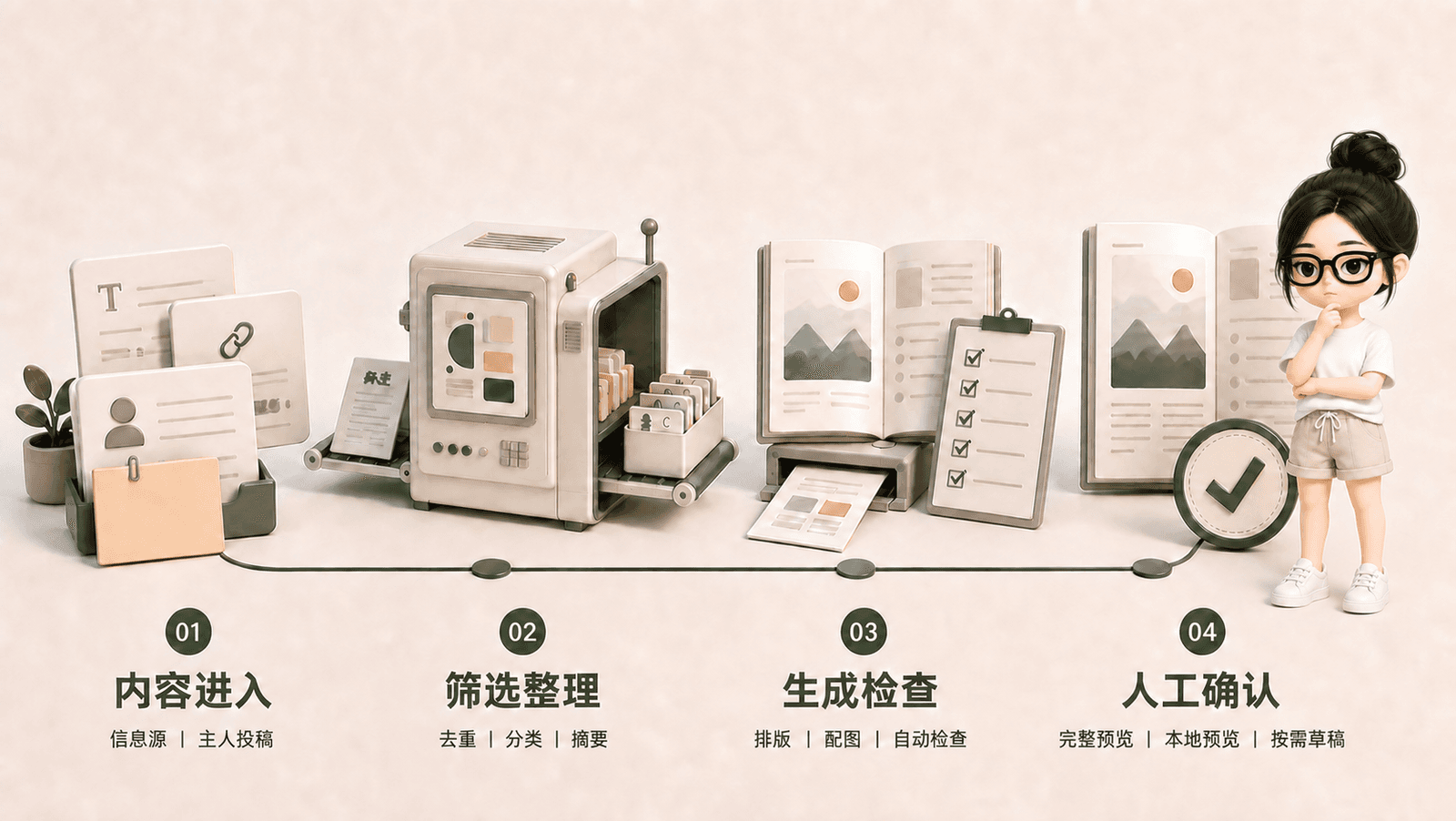
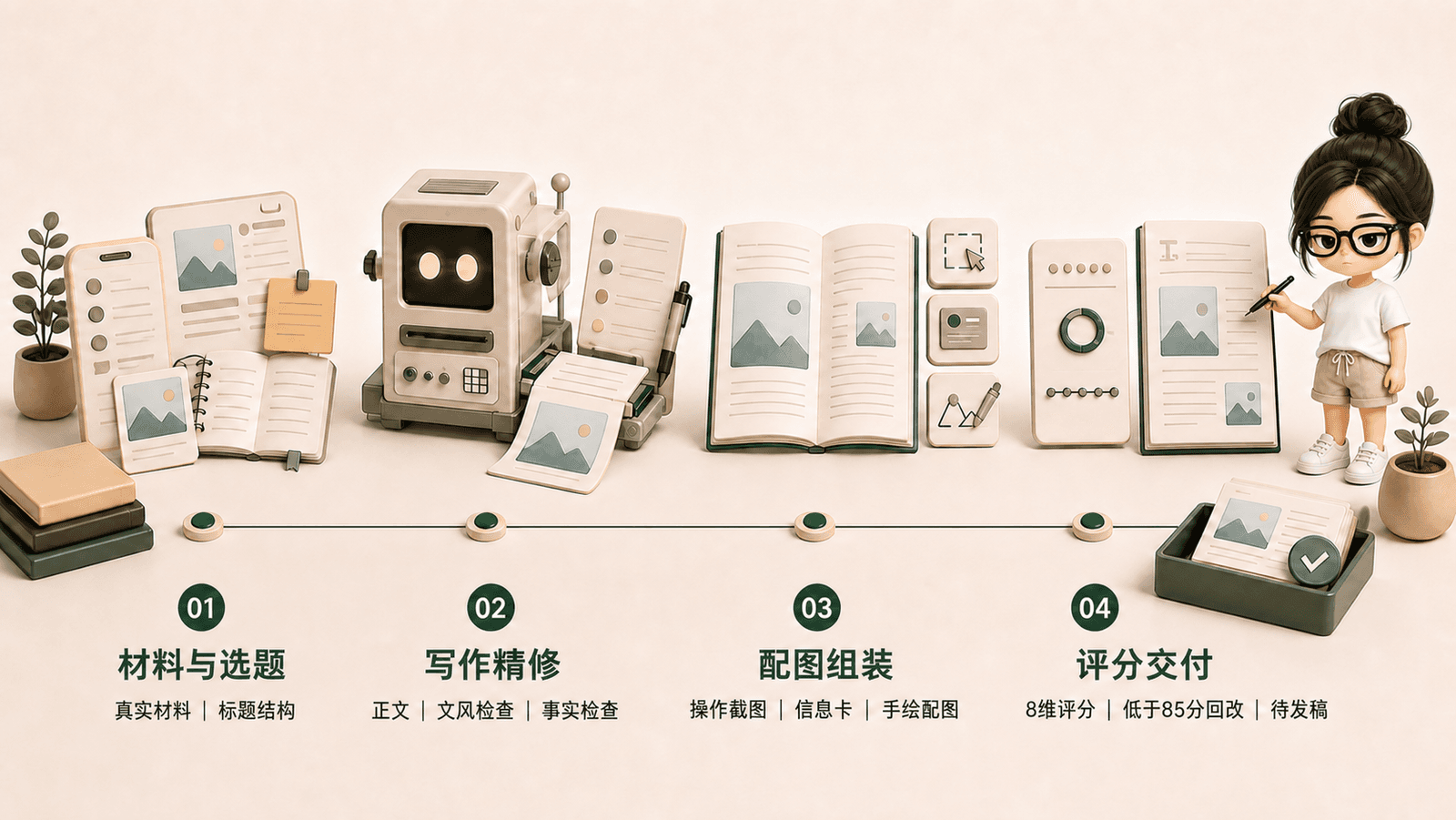
In use

Both projects are used in real production, retain human judgement, and continue to be calibrated through each use.

VALIDATING & BUILDING

Validation and build

Life System, Personal Wardrobe, UI Skill, and Design Twin are being validated, built, or explored and are shown according to their current level of completion.

01

Life System

Validating

A lightweight navigation system grounded in real actions and records, using Obsidian, daily notes, weekly planning, reviews, and AI collaboration to make trade-offs across life areas and gradually understand my decision patterns.

HYPOTHESIS

Can AI combined with long-term, real records help me understand myself more clearly and make steadier trade-offs across work, learning, creation, and life?

CORE PURPOSE

Its purpose is not to make life management more complex, but to use real actions, records, reading, AI, creation, and projects to understand myself over time and build an autonomous, rhythmic life that can sustain exploration. The system should serve real life and real projects rather than system-building itself.

WHY THIS
  • Material is scattered across Notion, Evernote, public posts, Xiaohongshu, reading notes, journals, and projects, without meaningful connections between them.
  • Saved material rarely becomes personal judgement, and the reasons behind past decisions are easily forgotten.
  • When work, reading, exercise, English, content, and AI exploration coexist, it is difficult to decide what matters most now.
  • Each AI collaboration requires re-explaining personal context, goals, and long-term projects instead of building continuous context.
  • The system must not become another large construction project; it should move real life and projects without adding excessive maintenance.
  • Long-term records may also allow ideas such as a one-person sample and game-like life visualisation to develop naturally.
PROGRESS
  1. Needs and principles✓
  2. Minimum action layer✓
  3. Eight-week testNow
  4. Cycle reviewNext
Verified
Life Map 0.1 is complete, and one weekly outcome, minimum daily notes, and weekly reviews are already moving real projects such as the new personal website forward.
Current
The first eight-week lightweight validation is testing whether the system can identify one weekly outcome, sustain multiple life areas, and move real projects rather than merely organise information.
Next
Complete the first eight-week review, assess practical value and maintenance cost, remove ineffective fields, and clarify the boundaries between the main line, maintenance areas, and parking lot.
Boundary
The current test is limited to the low-maintenance action layer; bulk history imports, a complex Obsidian architecture, persona systems, broad automation, and productisation are paused.

FuTalk Design Notes QR codeScan to follow FuTalk Design Notes

02

Personal Wardrobe

Validating

An AI wardrobe experiment grounded in real garments, body data, wearing feedback, daily contexts, and personal style—designed to activate what I own, judge whether new items are worth buying, and build a style system that does not depend on constant consumption.

HYPOTHESIS

Once AI continuously understands the clothes I own, my body data, try-on feedback, and real wearing habits, can it help me form a stable personal style more effectively than continuing to buy new clothes?

CORE PURPOSE

This is not about building a more complete digital wardrobe or recommending more things to buy each day. I want to test whether AI that truly knows what I own, what I wear, what I only like in theory, and my body and daily contexts can activate my existing wardrobe, reduce duplicate purchases, and gradually clarify my style judgement.

WHY THIS
  • I already own many clothes, but new items still trigger purchases based on whether one piece looks good rather than duplication or wardrobe fit.
  • Generic styling advice does not know what I own, recommends unavailable items, and cannot activate the existing wardrobe.
  • Colour alone is insufficient; cut, material, weight, season, body proportions, weather, and real contexts determine whether an outfit works.
  • Product and reference images are not real wear; try-ons, returns, comfort, frequency, and reasons for avoiding an item must be remembered.
  • I want personal style to mean understanding myself and building repeatable outfits, not continuing to buy more clothes.
PROGRESS
  1. Wardrobe and body data✓
  2. Real-wear validationNow
  3. Outfit relationshipsNext
  4. Stable style rulesLater
Verified
Decisions about keeping, returning, sizing, and outfits have begun to use owned garments, body measurements, size data, try-on photos, and wearing feedback rather than product images alone.
Current
Continuing to use real purchases, try-ons, returns, exchanges, and daily-wear records to see which judgements work and distinguish between liking, suitability, frequent wear, and existing substitutes.
Next
Turn repeatedly validated outfit, cut, colour, fabric, and purchase judgements into more stable personal wardrobe rules and reduce the cost of analysing them again each time.
Boundary
This stage does not pursue a complete digital wardrobe app, automatic recognition of all past garments, or complex recommendation algorithms; it first tests whether AI can reduce ineffective purchases and increase use of existing clothes.
FuTalk Design Notes QR codeScan to follow FuTalk Design Notes

03

UI Skill

Building

An AI collaboration method and long-term tool concept for real UI/UX work, preserving requirement understanding, information structure, interface judgement, and reflection while AI accelerates analysis and drafts and the designer retains direction and final refinement.

HYPOTHESIS

Can design knowledge, components, page patterns, usage rules, and project reviews be organised into a UI/UX capability that AI can reliably understand, retrieve, and apply?

CORE PURPOSE

I want AI to help organise requirements, research material, and generate drafts while the designer retains direction and final interface refinement. After each project, reusable components, page patterns, decision rules, and lessons should remain so the next project does not start from zero.

WHY THIS
  • Moving toward freelance work, remote collaboration, and personal products requires rebuilding and demonstrating combined UI and AI capability while improving solo efficiency.
  • AI can read PRDs, organise sources, research competitors, structure pages, and generate drafts, but it cannot replace business understanding, direction, and professional judgement.
  • What deserves preservation is not only the final interface but also core problems, open questions, information structure, accepted and rejected options, feedback, and revision reasons.
  • Components, page patterns, design rules, and project reflection should become personal UI assets reusable in future work.
  • Structured Figma should connect with MCP and code generation to reduce implementation loss, but only after validation through real and repeated workflows.
PROGRESS
  1. Direction and roles✓
  2. First workflowNow
  3. Incremental testsNext
  4. Codify after repetitionNext
Verified
A first collaboration flow and structured Figma rules are documented, and selected UI/UX cases have been reorganised around decisions and reflection.
Current
The core workflow, responsibility boundaries, and personal UI asset layer are defined and are being tested incrementally through real work such as the new personal website.
Next
Complete one representative Figma-to-code test with MCP and document what it genuinely saves and what still requires designer judgement.
Boundary
This is not yet a formal Skill, mature asset library, or stable Figma-to-code system, and is not presented as a standalone deliverable.
FuTalk Design Notes QR codeScan to follow FuTalk Design Notes

04

Design Twin / Personal Design Twin

Exploring

A long-term experiment asking whether a designer can train a personal AI twin, gradually structuring my design judgement, project experience, and UI methods through a knowledge base, Skills, model fine-tuning, and Agents so AI increasingly approaches how I handle real design projects.

HYPOTHESIS

Can a designer's long-developed tacit judgement be learned by AI and gradually become reusable, executable design capability that can eventually participate in real project delivery?

CORE PURPOSE

I am not testing whether AI can quickly generate a good-looking interface, but whether a designer's accumulated tacit experience—understanding requirements, finding problems, organising information, selecting options, and making trade-offs—can be made explicit and learned and applied by AI. I also want to start by training a small model, first becoming familiar with the basic steps of model training, then gradually testing whether personal design data genuinely affects the model's judgement. The long-term goal is to explore whether an independent designer can work with an AI design twin that increasingly understands them, taking on more analysis, options, and execution while the designer focuses on direction, critical decisions, and final quality.

WHY THIS
  • General-purpose AI can already generate interfaces and analyse products, but I still need to explain my background, experience, workflow, and preferences each time.
  • Design quality depends on more than drawing interfaces; it also depends on understanding requirements, unpacking the business, organising information, and making many trade-offs.
  • More than a decade of design work has produced many tacit judgements, but most remain in experience rather than data a machine can learn from.
  • If those judgements can be recorded and structured, AI may move from applying general design knowledge toward approximating my way of deciding.
  • UI Skill, past projects, design discussions, component standards, and project reviews can already provide knowledge and data for Design Twin.
  • I also want first-hand experience of training and fine-tuning language and multimodal models to understand how data and parameters shape behaviour.
  • The long-term question is whether a designer working with a personal AI twin can raise the ceiling of independent client work and end-to-end delivery.
PROGRESS
  1. Direction✓
  2. Design dataNow
  3. Design JudgeNext
  4. Model fine-tuning
  5. Visual judgement
  6. Design Agent
Verified
It is clear that Design Twin does not mean training a general model from scratch; it is more likely to combine a foundation model, personal design data, UI Skill, a knowledge base, model fine-tuning, and an Agent.
Current
Beginning to organise design processes from real projects into a Design Decision Dataset, recording requirement, problem, alternatives, choice, reason, and final result so experiential judgement becomes observable and reusable data.
Next
Prepare the first 30–50 real design decisions, build Design Judge v0.1, and run the first LoRA / SFT experiment with a small open model, comparing the base model, fine-tuned model, and my real judgement on unseen problems.
Boundary
This stage does not train a foundation model from scratch, pursue complete delivery-ready UI, or claim AI can independently replace a designer. It tests only whether AI can genuinely learn part of my design judgement.
FuTalk Design Notes QR codeScan to follow FuTalk Design Notes